From Daily Republic
By Ian Thompson
SUISUN CITY - The Suisun City train station on Main Street may become more than just a place to get on the train or the bus soon.
Kirk Knutson, owner of El Capitan Coffee Company and the person who now opens up the train station early in the mornings, is hoping the coffee stand he now runs there from 5 a.m. to 9 a.m. will become something greater.
"It is going to be awesome," Knutson said. "I have a lot of ideas I am going to run through the City Council."
Knutson was running a cafe in Woodland when the Greyhound Bus Company cut out its stop and the person who took tickets at the train station three weeks ago.
Suisun City officials, who knew Knutson when he ran a small coffee business at 333 Sunset Avenue some time ago, called him and asked if he would be interested in opening and closing the train station doors.
Knutson took on the duties and set up his coffee stand on Aug. 1 and early morning passengers using Amtrak have liked having the doors open so early as well as pastries and a cup of hot coffee at hand.
He would like to expand his business hours until 5 p.m. as well and offer sandwiches, soups and salads on several tables he would like to set up.
"It will be pretty nice," Knutson said of expanding what is now a brisk morning business.
Amtrak plans to offer more train service along the route and Knutson sees his business expanding along with that.
"With gas prices and airlines, people will be using Amtrak," Knutson said.
Suisun City Redevelopment Director Al da Silva called the new business "an evolving situation" that already allows the city to keep the train station open to residents.
Knutson's presence helps meet two Suisun City goals, da Silva said, keeping the station open and seeing it "put to a higher use."
"Eventually maybe we hope he will offer additional retail services," da Silva said. "We are talking with him about more permanent structure; maybe get into a formal agreement with a lease."
Reach Ian Thompson at 427-6976 or at ithompson@dailyrepublic.net.
Tuesday, August 22, 2006


Thursday, August 17, 2006
Pez dispensers, Pez collectors -- Husband, wife avid fans of iconic candy containers
From Daily Republic
By Ian Thompson
SUISUN CITY - Pez collector Dawn Stec says her favorite dispensers are the ones that look slightly used.
While some Pez collectors keep their prizes in their plastic wrapping, Stec said she likes to "free my Pez and fill them with candy.
"If I find one that has been used, it is more special to me because a child has probably used it," Dawn Stec said.
Her husband, Suisun City Police Sgt. Ted Stec, likes handing out Pez that look like police officers to his men during briefings and jokingly says the 50-plus police Pez dispensers the couple have "look like me."
The Pez Candy Inc. sells the candies that look like small bricks, dispensed from pocket-sized mechanical dispensers, according to the Wikipedia.com.
The name comes from the German word for peppermint, pfefferminz, the first Pez flavor. The candy was invented in Austria in 1927 and initially came in a small tin similar to modern Altoid tins.
The first dispensers, some of which are included in Dawn Stec's collection, looked like a cigarette lighter and dispensed the small breath mint as an alternative to smoking.
In 1952, Pez was introduced to America. Three years later, the company put heads on the dispensers and marketed them to children. These first head dispensers included Mickey Mouse, Santa Claus and Spacetrooper.The company is now headquartered in Traun, Austria, and produces more than 3 billion candy bricks a year in its American facilities alone. The dispensers are produced in Hungary and China.
Now, there are more than 450 unique dispenser heads with thousands of variations.
Name a cartoon character from Bugs Bunny to Snow White to Spongebob Squarepants and there is probably a Pez dispenser with his or her head on it.
"The Batman one (from the 1960s) is fairly rare because he has a cape," Dawn Stec said.
The list of the rarest, which the Stecs still don't have, includes a Lions Club Pez and a Make-A-Face Pez where the dispenser came with a 13 extra parts for people to make different faces. It was soon pulled from the market because the company thought the small parts represented a choking hazard for children.
The company has a general rule against putting likenesses of real people on its dispensers. It has only created three in its history - Betsy Ross, Daniel Boone and Paul Revere.
A bride and groom Pez duo the Stecs have is another of the rare dispensers.
"A Pez company employee had them created and they were given out as party favors for a wedding," Dawn Stec said.
Dawn Stec started her casual Pez collecting in high school when she starting picking up the colorful candy dispensers in the grocery store.
When she got a job in Fremont, Dawn Stec set up some of her collection at her desk and friends soon started bringing in Pez dispensers that they found and added them to her collection.
"It was then that I got a collection without realizing it," Dawn Stec said.
For the first 10 years, she kept her collection in a shoe box and thought her hobby of collecting Pez was fairly unique until she found another collector and saw his collection.
When Dawn Stec told her then-future husband Ted that she collected Pez and the worldwide extent of Pez collectors, Ted Stec said he was a little skeptical.
"Then I went to my first Pez convention and it convinced me this was all real," Ted Stec said. "It was a lot of fun to meet people who collected Pez dispensers."
The couple put up a table at the firemen's muster earlier this summer, selling firemen Pez dispensers to firefighters from all over the state who gathered in Old Town Suisun City.
Ted Stec also likes the sports Pez dispensers for baseball and football, as well as dispensers honoring the top drivers in NASCAR racing.
"I am looking forward to the Orange County Chopper Pez when it comes out," Ted Stec said.
Both Dawn and Ted Stec said their passion for Pez is nothing compared to Dawn's mother, Tina Gunsauls, who Dawn introduced to collecting several years ago.
"She does 10 times as much collecting as I do now," Dawn Stec said, also noting her mother runs a Pez selling business out of her home in Red Bluff.
Dawn's father even built an extension to the house to hold both his wife's and his daughter's Pez collection, but also to house Gunsauls' place of business.
As for where Dawn and Ted Stec would like to take their collecting, they said they would some day like to buy a live-work residence and set up a candy store that would feature Pez.
Unlike the chewing gum card collectors who immediately toss the obligatory stick of gum when they get their sports card pack, the Stecs say they also like the Pez candy too.
Reach Ian Thompson at 427-6976 or at ithompson@dailyrepublic.net.
By Ian Thompson
SUISUN CITY - Pez collector Dawn Stec says her favorite dispensers are the ones that look slightly used.
While some Pez collectors keep their prizes in their plastic wrapping, Stec said she likes to "free my Pez and fill them with candy.
"If I find one that has been used, it is more special to me because a child has probably used it," Dawn Stec said.
Her husband, Suisun City Police Sgt. Ted Stec, likes handing out Pez that look like police officers to his men during briefings and jokingly says the 50-plus police Pez dispensers the couple have "look like me."
The Pez Candy Inc. sells the candies that look like small bricks, dispensed from pocket-sized mechanical dispensers, according to the Wikipedia.com.
The name comes from the German word for peppermint, pfefferminz, the first Pez flavor. The candy was invented in Austria in 1927 and initially came in a small tin similar to modern Altoid tins.
The first dispensers, some of which are included in Dawn Stec's collection, looked like a cigarette lighter and dispensed the small breath mint as an alternative to smoking.
In 1952, Pez was introduced to America. Three years later, the company put heads on the dispensers and marketed them to children. These first head dispensers included Mickey Mouse, Santa Claus and Spacetrooper.The company is now headquartered in Traun, Austria, and produces more than 3 billion candy bricks a year in its American facilities alone. The dispensers are produced in Hungary and China.
Now, there are more than 450 unique dispenser heads with thousands of variations.
Name a cartoon character from Bugs Bunny to Snow White to Spongebob Squarepants and there is probably a Pez dispenser with his or her head on it.
"The Batman one (from the 1960s) is fairly rare because he has a cape," Dawn Stec said.
The list of the rarest, which the Stecs still don't have, includes a Lions Club Pez and a Make-A-Face Pez where the dispenser came with a 13 extra parts for people to make different faces. It was soon pulled from the market because the company thought the small parts represented a choking hazard for children.
The company has a general rule against putting likenesses of real people on its dispensers. It has only created three in its history - Betsy Ross, Daniel Boone and Paul Revere.
A bride and groom Pez duo the Stecs have is another of the rare dispensers.
"A Pez company employee had them created and they were given out as party favors for a wedding," Dawn Stec said.
Dawn Stec started her casual Pez collecting in high school when she starting picking up the colorful candy dispensers in the grocery store.
When she got a job in Fremont, Dawn Stec set up some of her collection at her desk and friends soon started bringing in Pez dispensers that they found and added them to her collection.
"It was then that I got a collection without realizing it," Dawn Stec said.
For the first 10 years, she kept her collection in a shoe box and thought her hobby of collecting Pez was fairly unique until she found another collector and saw his collection.
When Dawn Stec told her then-future husband Ted that she collected Pez and the worldwide extent of Pez collectors, Ted Stec said he was a little skeptical.
"Then I went to my first Pez convention and it convinced me this was all real," Ted Stec said. "It was a lot of fun to meet people who collected Pez dispensers."
The couple put up a table at the firemen's muster earlier this summer, selling firemen Pez dispensers to firefighters from all over the state who gathered in Old Town Suisun City.
Ted Stec also likes the sports Pez dispensers for baseball and football, as well as dispensers honoring the top drivers in NASCAR racing.
"I am looking forward to the Orange County Chopper Pez when it comes out," Ted Stec said.
Both Dawn and Ted Stec said their passion for Pez is nothing compared to Dawn's mother, Tina Gunsauls, who Dawn introduced to collecting several years ago.
"She does 10 times as much collecting as I do now," Dawn Stec said, also noting her mother runs a Pez selling business out of her home in Red Bluff.
Dawn's father even built an extension to the house to hold both his wife's and his daughter's Pez collection, but also to house Gunsauls' place of business.
As for where Dawn and Ted Stec would like to take their collecting, they said they would some day like to buy a live-work residence and set up a candy store that would feature Pez.
Unlike the chewing gum card collectors who immediately toss the obligatory stick of gum when they get their sports card pack, the Stecs say they also like the Pez candy too.
Reach Ian Thompson at 427-6976 or at ithompson@dailyrepublic.net.
Saturday, June 17, 2006
On the Waterfront ... Transformation leads more and more people to rediscover Suisun City
From Vacaville Reporter
By Amanda Janis/Business Writer
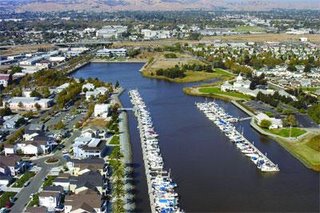
Rewarding results from more than 20 years of redevelopment efforts are increasingly tangible in Suisun City's waterfront area.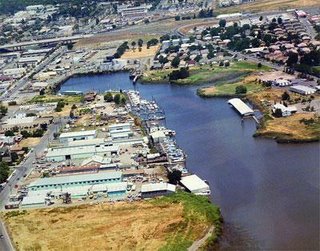
A quick glance at the dramatic "before and after" photos makes plain the once grim, crime-ridden area has undergone an incredible transformation through the years into a charming little waterfront and marina peppered with alluring shops, restaurants, and entertainment.
Debuting just days ago, in fact, was www.suisunwaterfront.com - a new Website dedicated to the waterfront, its businesses and numerous outdoor markets and events, as well as its history and redevelopment. The site is just one of the projects of the Suisun Historic Waterfront Business Improvement District, a consortium of the area's business owners who've been working hard for several years to brand and promote Suisun City.
Their (voluntary) efforts in tandem with city's seem to be working. The marina's vacancy rate is one of the lowest in the county, with its guest dock frequently full on weekends. Events are well attended - more than 15,000 are estimated to have visited last year's Fourth of July festivities. And more development is in the pipeline.
"It's a huge difference," acknowledged Scott Corey, Suisun City spokesman.
Corey explained the area had its beginnings as an industrial shipping center, as ships from San Francisco would arrive to procure goods from surrounding valleys, but the harbor was eventually bypassed by the interstate highway system, and as shipping declined, Corey said, "everything just sort of changed."
"The waterfront became the place where you put everything you didn't want to see anywhere else in town," he said, "so what we ended up with were a bunch of industrial uses and various things that just don't scream out this is a beautiful place to be."
Furthermore, he noted, the marina was riddled with dilapidated docks and partially sunken boats and was bordered by "The Crescent" - a high-density, high-crime neighborhood that consumed well over half of the city's law enforcement budget.
"It just was not a good place to be," Corey said.
The city decided to step in, he explained, and set up a redevelopment agency in the early '80s. Bonds to the tune of $60 million were issued to pay for the extensive make-over. Much property was purchased, cleared and cleaned, Crescent residents were relocated as the neighborhood was demolished, and the marina infrastructure was created.
A 5,000-foot waterfront promenade was built, as was a downtown plaza with outdoor stage, a 170-seat theater, and new pedestrian oriented residential neighborhoods including live/work units.
"Really, we just started pouring investment into the downtown," Corey said, noting that a good deal of that investment - such as dredging the harbor and constructing sea walls - is literally underground.
The city's substantial investment and commitment to its vision of the waterfront as an attraction convinced many business owners and investors to "Rediscover Suisun" - as the slogan conceived by the business improvement district urges.
That's one of two reasons The Wiseman Company developed One Harbor Center, a 50,000-square foot, three-story, upscale office building that overlooks the water.
President Doyle Wiseman explained that the city's positive attitude about redevelopment was a major attraction. "You had the feeling that it's only going to get better," he said. "That was a factor - that local government, particularly for such a small city, has been very effective. It's a can-do government."
Corey confirmed, "It is the high priority project for us, from the city council on down."
And the other reason The Wiseman Co. believed Suisun City to be a sound investment?
"The Suisun City waterfront is very unique in the county - there's nothing else like it," Wiseman said. "It's just a wonderful place to go every day. People like being there."
Michelle Hicks, owner of waterfront business Yoga Junction, concurs.
"I grew up in Vacaville," she noted, "and Suisun had always been an armpit, where you never wanted to go. I hadn't visited there in a long time even though I live in Cordelia."
As she looked for a new home for her yoga studio, she said, "Something told me to go visit. I went to lunch at the Athenian Grill and I was blown away by how beautiful they had made downtown Suisun."
The feel of the revitalized waterfront area, coupled with its numerous festivals, Hicks said, made her want to join the community.
"I'm delighted to be a part of it and I think it's only going to get better," she said. "It's exciting to see a town turn itself around and they've really done a good job. I think there's still lot of people who don't realize, like I didn't, what it's become. So many people still don't know where Suisun is, and I think that's going to change. I think it's going to be a real hub for people."
As does Shelly Kontogiannis, president of the Suisun Historic Waterfront Business Improvement District, and owner of the Athenian Grill located in Harbor Plaza. The second building on the waterfront, the Athenian Grill has been operating successfully for nine years, and its property value has more than doubled, Kontogiannis said.
"It's just going to get better as time goes on and the development is happening," she asserted.
She is referring to the Main Street West project, which entails redevelopment of 13 parcels near the waterfront, Main Street and Civic Center Boulevard by Main Street West Partners, LLC.
The centerpiece of the project, which will likely break ground in late August, will be several two-story mixed-used buildings constructed in a plaza-style fashion on the corner of Solano and Main streets.
Completion of the first phase of the Main Street West project, Corey said, will work as a catalyst for redevelopment of neighboring parcels.
Similar sentiments were shared by Garry Rowe, who runs Family Values Magazine from one of the live/work units bordering the promenade.
"Main Street West is going to break the whole thing open," Rowe predicted. "I think 2010 is really going to be our year - you'll see a vibrant downtown where on a Friday or Saturday night you're going to have a hard time getting into a restaurant, you're going to see a lot of people walking around having a good time, you'll see people in public courtyards enjoying music or strolling up the promenade."
In the next two years alone, Rowe, said, "We're anticipating space for 30-40 new businesses."
The challenge, Corey noted, is in ensuring that good development decisions are made, and the city is being very selective about what fills the waterfront space, working closely with Main Street West Partners.
"We're at this juncture. We've done all the sort of heavy-lifting, major investments into the waterfront," he said. "We've created a terrific environment, an environment people want to go to, a place that's now economically viable. We have the assets. Now we're moving into that phase of putting in the things we'd always envisioned here, making it a destination."
Amanda Janis can be reached at business@thereporter.com.
By Amanda Janis/Business Writer
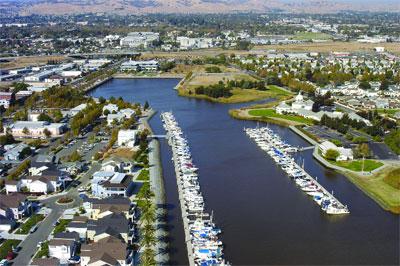
Rewarding results from more than 20 years of redevelopment efforts are increasingly tangible in Suisun City's waterfront area.
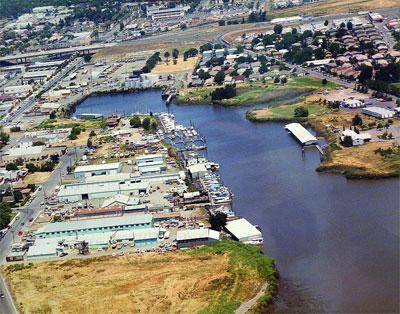
A quick glance at the dramatic "before and after" photos makes plain the once grim, crime-ridden area has undergone an incredible transformation through the years into a charming little waterfront and marina peppered with alluring shops, restaurants, and entertainment.
Debuting just days ago, in fact, was www.suisunwaterfront.com - a new Website dedicated to the waterfront, its businesses and numerous outdoor markets and events, as well as its history and redevelopment. The site is just one of the projects of the Suisun Historic Waterfront Business Improvement District, a consortium of the area's business owners who've been working hard for several years to brand and promote Suisun City.
Their (voluntary) efforts in tandem with city's seem to be working. The marina's vacancy rate is one of the lowest in the county, with its guest dock frequently full on weekends. Events are well attended - more than 15,000 are estimated to have visited last year's Fourth of July festivities. And more development is in the pipeline.
"It's a huge difference," acknowledged Scott Corey, Suisun City spokesman.
Corey explained the area had its beginnings as an industrial shipping center, as ships from San Francisco would arrive to procure goods from surrounding valleys, but the harbor was eventually bypassed by the interstate highway system, and as shipping declined, Corey said, "everything just sort of changed."
"The waterfront became the place where you put everything you didn't want to see anywhere else in town," he said, "so what we ended up with were a bunch of industrial uses and various things that just don't scream out this is a beautiful place to be."
Furthermore, he noted, the marina was riddled with dilapidated docks and partially sunken boats and was bordered by "The Crescent" - a high-density, high-crime neighborhood that consumed well over half of the city's law enforcement budget.
"It just was not a good place to be," Corey said.
The city decided to step in, he explained, and set up a redevelopment agency in the early '80s. Bonds to the tune of $60 million were issued to pay for the extensive make-over. Much property was purchased, cleared and cleaned, Crescent residents were relocated as the neighborhood was demolished, and the marina infrastructure was created.
A 5,000-foot waterfront promenade was built, as was a downtown plaza with outdoor stage, a 170-seat theater, and new pedestrian oriented residential neighborhoods including live/work units.
"Really, we just started pouring investment into the downtown," Corey said, noting that a good deal of that investment - such as dredging the harbor and constructing sea walls - is literally underground.
The city's substantial investment and commitment to its vision of the waterfront as an attraction convinced many business owners and investors to "Rediscover Suisun" - as the slogan conceived by the business improvement district urges.
That's one of two reasons The Wiseman Company developed One Harbor Center, a 50,000-square foot, three-story, upscale office building that overlooks the water.
President Doyle Wiseman explained that the city's positive attitude about redevelopment was a major attraction. "You had the feeling that it's only going to get better," he said. "That was a factor - that local government, particularly for such a small city, has been very effective. It's a can-do government."
Corey confirmed, "It is the high priority project for us, from the city council on down."
And the other reason The Wiseman Co. believed Suisun City to be a sound investment?
"The Suisun City waterfront is very unique in the county - there's nothing else like it," Wiseman said. "It's just a wonderful place to go every day. People like being there."
Michelle Hicks, owner of waterfront business Yoga Junction, concurs.
"I grew up in Vacaville," she noted, "and Suisun had always been an armpit, where you never wanted to go. I hadn't visited there in a long time even though I live in Cordelia."
As she looked for a new home for her yoga studio, she said, "Something told me to go visit. I went to lunch at the Athenian Grill and I was blown away by how beautiful they had made downtown Suisun."
The feel of the revitalized waterfront area, coupled with its numerous festivals, Hicks said, made her want to join the community.
"I'm delighted to be a part of it and I think it's only going to get better," she said. "It's exciting to see a town turn itself around and they've really done a good job. I think there's still lot of people who don't realize, like I didn't, what it's become. So many people still don't know where Suisun is, and I think that's going to change. I think it's going to be a real hub for people."
As does Shelly Kontogiannis, president of the Suisun Historic Waterfront Business Improvement District, and owner of the Athenian Grill located in Harbor Plaza. The second building on the waterfront, the Athenian Grill has been operating successfully for nine years, and its property value has more than doubled, Kontogiannis said.
"It's just going to get better as time goes on and the development is happening," she asserted.
She is referring to the Main Street West project, which entails redevelopment of 13 parcels near the waterfront, Main Street and Civic Center Boulevard by Main Street West Partners, LLC.
The centerpiece of the project, which will likely break ground in late August, will be several two-story mixed-used buildings constructed in a plaza-style fashion on the corner of Solano and Main streets.
Completion of the first phase of the Main Street West project, Corey said, will work as a catalyst for redevelopment of neighboring parcels.
Similar sentiments were shared by Garry Rowe, who runs Family Values Magazine from one of the live/work units bordering the promenade.
"Main Street West is going to break the whole thing open," Rowe predicted. "I think 2010 is really going to be our year - you'll see a vibrant downtown where on a Friday or Saturday night you're going to have a hard time getting into a restaurant, you're going to see a lot of people walking around having a good time, you'll see people in public courtyards enjoying music or strolling up the promenade."
In the next two years alone, Rowe, said, "We're anticipating space for 30-40 new businesses."
The challenge, Corey noted, is in ensuring that good development decisions are made, and the city is being very selective about what fills the waterfront space, working closely with Main Street West Partners.
"We're at this juncture. We've done all the sort of heavy-lifting, major investments into the waterfront," he said. "We've created a terrific environment, an environment people want to go to, a place that's now economically viable. We have the assets. Now we're moving into that phase of putting in the things we'd always envisioned here, making it a destination."
Amanda Janis can be reached at business@thereporter.com.
Subscribe to:
Posts (Atom)